Saturday, July 29, 2006

Visualization of Whole-Brain Connectivity
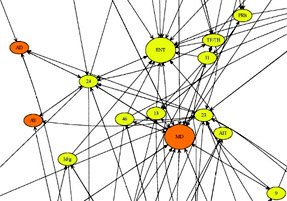
Growing up in the internet age, most of us are very familiar with network diagrams of all sorts. Indeed, this is also the age of the network. But surprisingly, while there are diagrams for almost every type of network you can conceive of, there is a remarkable lack of such diagrams for whole-brain connectivity. Why is that? The closest anyone has come has been limited to cortical connectivity diagrams (Felleman and van Essen (1991), Malcolm Young, Kotter et al, etc), and in those cases, the connectivity data was either outdated, incomplete, or both.


I have recently noticed whole-brain connectivity diagrams at BrainMaps.org, and although it still appears to be a work in progress, the results thus far seem fairly impressive. It remains to be seen whether the graphing methods they are employing will scale to deal with hundreds of nodes with thousands of edges.
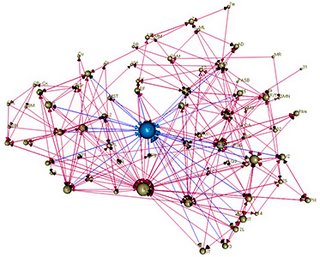


UPDATE!!! Interactive visualization of brain connectivity in 3D! According to the Download Page:
Welcome to nodes3D, a 3D graph visualization program written by Issac Trotts in consultation with Shawn Mikula, in the labs of Edward G. Jones. On startup, nodes3d will download a graph of gross neuroanatomical connectivity from the MySQL database at brainmaps.org. Also supports loading of graphs from files or other databases.


Very Cool!

Wednesday, July 05, 2006

Much Ado About Mirror Neurons

Fewer "discoveries" in neuroscience have garnered more undue hype than that of mirror neurons. Discovered by some Italians in the late 90's, mirror neurons were hailed as some major discovery. Here is an excerpt from an article written earlier this year by New York Times writer, Sandra Blakeslee:

"It took us several years to believe what we were seeing," Dr. Rizzolatti said in a recent interview. The monkey brain contains a special class of cells, called mirror neurons, that fire when the animal sees or hears an action and when the animal carries out the same action on its own. But if the findings, published in 1996, surprised most scientists, recent research has left them flabbergasted.

Flabbergasted? Get serious, Sandra!!    Mirror neurons, which are found predominantly in premotor cortex, are obviously involved with motor imagery, which we perform both when we watch others performing actions and also when we perform the same actions. There's no mystery here, and nothing surprising. In fact, when I first heard about mirror neurons some years back, I thought, "So what, big deal!". The existence of mirror neurons should have come as no surprise. The Italian researchers, by disingenuously choosing to call these neurons "mirror neurons", set the stage for the hype that was to follow and for misinterpretations galore.

Just for kicks, try googling for "mirror neurons" and you'll get 173,000 results, whereas googling for "cortical column" only returns 27,800 results. Why is that? The cortical column is a much older, more established, and more surprising discovery than mirror neurons, yet the internet is rife with the mirror neuron literature, as if this were some important discovery.

I have even met people who believe that mirror neurons are involved with telepathy and supernatural abilities! This is a direct consequence of all the excessive media hype which surrounds mirror neurons. This hype is complete nonsense. It is just adding more noise and obscures what is truly profound about the brain.

Shame on you, media specialists and science writers, for propagating this nonsense! You do the field of neuroscience a great disservice by turning it into a circus of stupidity and disinformation. If you are unable to report on neuroscience discoveries competently, then you should have the moral sense to choose not to report on them at all.

Are the Italian researchers also at fault for allowing this mirror neuron nonsense to explode out of proportions? Yes, but seriously, people should know not to believe everything other people tell them, and this includes scientists who seek their own advantage at the cost of truth and the greater benefit to all. The Italian researchers were either 1) deluded into believing they had made some great discovery, or more likely, 2) were just trying to garner public and media attention to their work regardless of the merit of said work. Their work clearly does not merit the media attention it has received, and it is the fault of both the researchers who falsely pump up their results into "great discoveries" and of the media and science-tech writers who don't have the intellectual acumen to assess the significance of neuroscientific results.