Tuesday, July 10, 2007

The Brain Maps API


BrainMaps.org has recently implemented a new AJAX-enabled multiresolution image viewer. Though a bit skimpy on functionality compared to the heavy-weight Flash viewers, it is snappy fast, uses very little memory, and in principle, allows for better integration with other HTML entities through DOM. An example is at http://brainmaps.org/ajax-viewer.php?datid=95&sname=123

What's more, the multiresolution viewer has been released as the Brain Maps API. The following is from the Brain Maps API page:

"The Brain Maps API lets you embed Brain Maps in your own web pages with JavaScript. Future versions will enable you to add overlays to brain maps (including markers and polylines) and display shadowed "info windows". The Brain Maps API is a free service, available for any web site that is free to consumers."

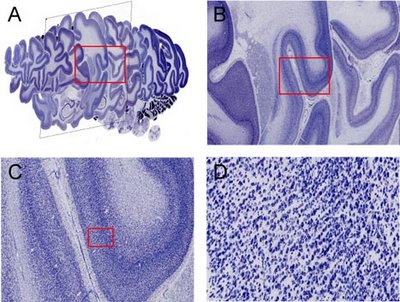
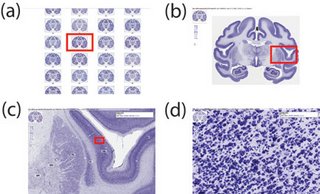
An example of the new Brain Maps AJAX GUI, which is a more beefed-up version of the Brain Maps API, is shown below:

Try going to this link to see what all the fuss is about, and once there, try clicking and dragging the image, or clicking on the little tree icon in the upper right. Also, the mouse scroll wheel should zoom you in and out.

Google Maps for the Brain? Not quite yet. It still needs image overlays and labels. But that being said, it's the best I've seen yet.

Labels: ,

Wednesday, January 17, 2007

3D Brain

I recently wanted to see where acetylcholinesterase (AChE), the enzyme that breaks down the neurotransmitter acetylcholine, is located in the brain. And specifically, I wanted to see the distribution of AChE in 3D. This data is available online (for the mouse brain) at both the Allen Brain Atlas and BrainMaps.org, so I went to both sites to see the AChE distribution in 3D. Here I was veritably shocked by the comparison. First, let's look at the Allen Brain Atlas 3D file for AChE, which is the big yellow amorphous blob shown on the right


Then I went to BrainMaps.org and obtained the 3D file for the AChE distribution in the mouse brain, and this is what it looks like in the figure to the right. Note that in both of these figures, the viewpoint is oblique lateral, with anterior pointing to the left and spinal cord on the right.

Understandably, I was shocked by the difference in quality between the two 3D distributions. First off, I have difficulty interpreting the first figure (from the Allen Brain Atlas) because it is just a big amorphous blob of yellow spots.

Secondly, and more troublesome, is that the first figure (from the Allen Brain Atlas) is just plain incorrect. The distribution of AChE, in 2D, looks like the figure at the right. Here we see that AChE is located primarily in the striatum (the dark red color). The striatum is clearly discernible in the second figure (from BrainMaps.org) but is not visible at all in the first figure (from the Allen Brain Atlas).

And here's the kicker: it's not just AChE where the Allen Brain Atlas data is completely wrong!   Nonetheless, it's not the objective of this article to be critical of the Allen Brain Atlas since I have done this elsewhere. I will only note that $40 million should have resulted in decent 3D reconstructions, and better quality in situ data. The fact that so much money was poured into this project and it just produced a pile of crap still astounds me, since it goes against the GIGO (garbage in, garbage out) rule, or at least requires a modification, courtesy of Paul Allen: "$40 million in, garbage out". Granted, it's not as euphonious as GIGO, but it works.

In any event, the objective of this article is to consider 3D brains and how to render 3D brain structures and distributions. We have polygonal modeling, which is currently employed at brainmaps.org, but this has the drawback that surfaces need to be defined, which may not be practical for continuous distributions. Surfaces may be considered "isosurfaces" of a continuous distribution, but what if we want to view the complete distribution in 3D? Then we're talking about volumetric visualization and not surface visualization (unless you're talking about isosurfaces of a volume).

Surfels are one possibility too, but suffer from poor rendering and performance issues. So what we are left with, apparently, is polygons as the best way to visualize the brain in 3D.

The 3D brains used in the figures above, and more, are located at the 3D Brain Objects Database at BrainMaps.org. Note that you can view the 3D brains directly in your browser!

Labels: ,

Thursday, September 14, 2006

Google Earth for the Brain


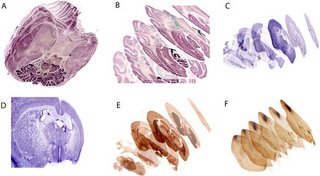
If BrainMaps.org is like Google Maps for the Brain, StackVis is Google Earth for the Brain. Welcome to StackVis, a 3D viewer of neuroanatomical sections.


Google Earth for the BrainFigure Caption. The development of additional desktop application tools for interacting with brainmaps.org image and database data includes the one shown here, StackVis, which is a 3D viewer of neuroanatomical virtual slide image stacks that is integrated with high resolution viewing of and interaction with individual sections comprising the image stack. (A) horizontal image stack of nissls of the macaque brain viewed from below. (B) same image stack as in (A) but from a different perspective, with increased inter-section spacing, and with areal and nuclear labels. (C) coronal image stack of nissls of the mouse brain. (D) a section from (C) viewed at higher resolution. (E) coronal image stack of acetylcholinesterase reacted sections of the mouse brain. (F) sagittal image stack of the mouse brain reacted for biotinylated dextran amine (BDA) following an injection in frontal cortex. Note that labeled fibers can be followed within the image stack due to section transparency and that individually labeled subcortical structures can be discerned, allowing for an assessment of labeled fiber pathways and areas within a 3D framework. In addition, StackVis features automated section registration and edge detection capabilities.

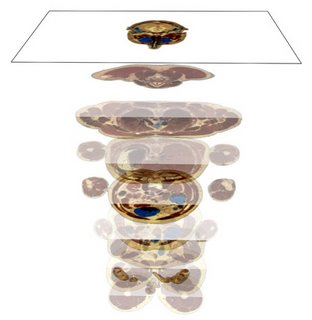
Figure Caption. Viewing the Visible Male using StackVis. The sections are axial, and are arranged in this figure so that the brain is located at the top and the legs are located at the bottom of the image stack.

Labels: , , ,

Thursday, August 24, 2006

Virtual Microscopy a Disruptive Technology?

Virtual microscopy is a method of posting microscope images on, and transmitting them over, computer networks. This allows independent viewing of images by large numbers of people in diverse locations.

Prior to recent advances in virtual microscopy, slides were commonly digitized by various forms of film scanner and image resolutions rarely exceeded 5000 dpi. Nowadays, it is possible to achieve more than 100,000 dpi and thus resolutions approaching that visible under the optical microscope. This increase in scanning resolution comes at a price; whereas a typical flatbed or film scanner ranges in cost from $200 to $600, a 100,000 dpi slide scanner will range from $80,000 to $200,000.

Virtual microscopy has been characterized as potentially a disruptive technology. A disruptive technology is a new technological innovation, product, or service that eventually overturns the existing dominant technology in the market, which in this case would be real (i.e., conventional) microscopy. Our experience with virtual microscopy suggests that it is unlikely to replace real microscopy any time soon, but for the time being, it nicely complements and extends the capabilities of real microscopes. Specifically, we find a three-fold extension of virtual microscopy over real microscopy in the following areas: 1) data-sharing and remote access, 2) data-management and annotation, and 3) data-mining. Data management and data-mining of virtual (digitized) slides are capabilities that cannot be directly applied to real slides. In addition, the online distribution and sharing of virtual slides with anyone with an internet connection ensures the rapid dissemination of neuroanatomical data that otherwise would not be possible. While largely emphasizing the pros of virtual slides in this article, it is worthwhile to point out the cons. Namely, it is not possible to change focus in a virtual slide as it is in a real slide. Normally, this is not a problem since virtual slides tend to be completely in focus. However, the inability to change the plane of focus in a virtual slide rules out their use in unbiased stereological estimation methods that require optical dissectors. Nonetheless, biased sterelogical estimation methods, or unbiased methods not using optical dissectors, are still possible. Another drawback is that the resolution of the virtual slide is limited to the optical lens used in the scanner. For example, if we generate a virtual slide at 20x and subsequently want to examine part of the slide at 40x, then it is necessary to rescan the entire slide using the higher objective, which in some cases, is not possible due to file size restrictions or hardware issues. Finally, at the time of writing, virtual microscopy does not deal well with fluorescence, and is only recommended for light microscopy.

Virtual microscopy-based digital brain atlases are superior to conventional print atlases in five respects: 1) resolution, 2) annotation, 3) interaction, 4) data integration, and 5) data-mining. The resolution of conventional print brain atlases typically does not exceed 7200 dpi, whereas virtual microscopy-based digital brain atlases attain 100,000 dpi and offer the ability to zoom in and out. Annotation can be more complete in virtual microscopy-based digital brain atlases, with options to display some types of annotations and make the rest invisible. Greater interactivity means that the user can zoom in/out and pan through brain image data, which is not possible in print-based atlases. Data-integration capabilities, including the integration of connectivity and gene expression data, are superior for the virtual microscopy-based digital brain atlases. And finally, the ability to data-mine virtual microscopy-based digital brain atlases is a feature not available for print-based atlases. While we do not foresee virtual microscopy-based digital brain atlases completely replacing conventional print-based brain atlases, we expect that they will be progressively more commonly used in place of print-based atlases.

What I'd like to know is, how likely is virtual microscopy to overtake regular microscopy and print atlases in the near future? In my opinion, conventional print brain atlases are a ripoff, often costing over $200 each. The idea of having this information freely available online is very tantalizing and welcome.

In other news, Society for Neuroscience 2006 is fast approaching! Hope to see you all in Atlanta this Oct 14-18.

Labels: , ,

Sunday, April 16, 2006

Collaborative Digital Brain Mapping Comes of Age

Google Maps and related geomapping services provide high-resolution satellite maps to anyone with an internet connection and have set the standard for online digital mapping. We are now beginning to witness similar digital mapping technologies spilling over into other non-related fields, one of the more interesting of which is neuroscience and the collaborative digital mapping of the brain.

Launched less than a year ago, BrainMaps.org has rapidly developed to lead the field in digital brain mapping technologies. With several terabytes of ultra high-resolution brain image data, consisting of several dozen mouse, monkey, and human brains, its online brain image database is the largest and most diverse currently available. This massive image data is integrated with structural information regarding spatial locations of different brain areas and markers, and the relations between them. And in the collaborative spirit, online users are free to add their own labels and annotations, and to place landmarks throughout the digital brains they explore. Users may even share their images, landmarks, and other annotations with other users in the BrainMaps forum, which in many ways parallels the Google Maps Community, but on a smaller scale.

The U.S.-sponsored 'Decade of the Brain' has come and gone; it officially ended in the year 2000. It would take another five years before BrainMaps.org came onto the scene, and in a way, it encapulates what the Decade of the Brain should have been about: Collaborative digital brain mapping and a resource available to everyone with an internet connection.

Labels: ,